"Visualising Mental Illness": A Rhetorical Analysis
Mental illness is a complicated and nebulous struggle that's different for each individual who experiences it. Further, it's even more complicated to try to convey that experience to one another - especially those who have never suffered from mental illness.
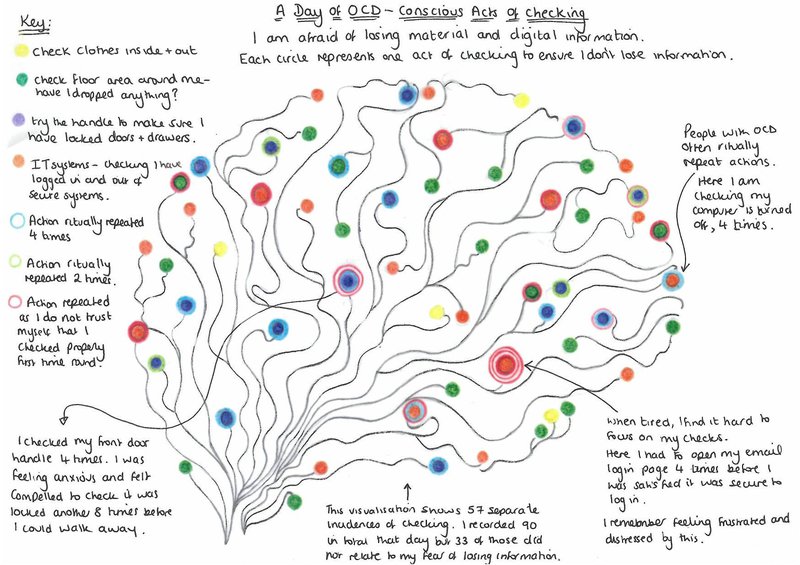
Jill Simpson uses a colorful, artistic, and picturesque representation to illustrate a disorder that is often quite far from picturesque - Obsessive-Compulsive Disorder. Given that her explanation of the disorder is clear and comprehensive, I'll refrain from rehashing its definition and symptoms here.
The illustration above utilizes vibrant colors and specific labels to clearly convey the daily actions and thoughts of an individual with OCD. Neat balls and rings of distinct colors litter the page with rather random placement, but the squiggled lines that are attached to and connect those colors form an artistic depiction of a sagittal view of the human brain. While I assume the "font" used is just Simpson's handwriting, its neat yet almost whimsical nature pairs well with the ornate design of the image.
A facet of the illustration that I find particularly interesting is that the chaotic dots and curved lines have been so perfectly brought together to display the brain. Not only that, but within the chaos, the dots, rings, and lines themselves are extremely neat and clean. This seems to add another layer to the depiction - despite the randomness of the individual parts, they've been precisely and painstakingly gathered into a perfect image. Thus, one might assume that the amount of time and effort that Simpson put into crafting this illustration could be likened to the amount of time and effort she spends coping with her OCD on a daily basis.
Simpson intended to convey the chaos of OCD to a primarily neurotypical audience in the hopes of increasing "awareness, understanding, and empathy" for those who do suffer from mental illness. As someone who lives with a mental disorder myself and dates someone with OCD, I can't personally say whether or not this depiction would reach someone neurotypical. However, it definitely reached me. And if I were to venture a guess, I'd say that the chaotic-yet-clean nature of this illustration does an effective job of depicting the struggle of OCD to the intended audience.
Comments
Post a Comment